[Home]
Computer Theology
Intelligent Design of the World Wide Web
Bertrand du Castel and Timothy M. Jurgensen
(Notes by Bertrand du Castel)
Saturday, January 30, 2010
Shed the mask
An example of physical masking is noise from the street that makes the speech hardly audible. An example of informational masking is interfering conversations that make it hard to make sense out of the speech. The authors study those distinctions for a better understanding of human auditory processing.
The question I'm wondering about is how prevalent is masking, both physical and informational, in our perceptory system and its accompanying processing capabilities. The shadow of night is physical masking, and the combination of odors is informational masking. Venetians masks are both physical and informational maskings?
A person with a mask has an identity, just as the same person without a mask. Those identities are at the same time same and different. In terms of Computer Theology (p. 304), the explanation is that the two different identities are those of the person with the mask and of the person without the mask. We call those identities differential. But there is another identity, which we call experiential. In this case, there is one experiential identity for the person in front of you, whether carrying or not carrying a mask.
Back to the auditory system. Is physical masking experiential and informational masking differential? Let me know what you think.
Sunday, January 24, 2010
Olfaction or consciousness?
Their interest is in identifying vectors of research similar to those of other sensations, like pitch and frequency for auditory signals, in order to support a parallel investigation for olfactory signals, even though those latter signals are processed by the brain differently from other signals; olfactory signals go directly to the cortex before going to the thalamus, whereas other signals go to the thalamus first.
My interest here is different, and I definititely plead weirdly ignorant here. There is something in my own feeling of consciousness that is reminiscent of my feeling of odor. This is just a hunch. When I say "I feel good this morning", it that pleasantness related to consciousness; and if it is, is that pleasantness scale similar to that of odor in terms of its relationship to a physical vector which would be that of consciousness?
Saturday, January 23, 2010
Rituals and attention
Therefore these findings suggest that inter-areal communication during attentional top-down control is conveyed particularly through rhythmic synchronization in a high beta band, either in addition to or separate from the frequency of rhythmic interactions underlying bottom-up feedforward signaling.
Top-down attention is directed attention, as in "look at that cat," while bottom-up attention is triggered attention, as in "something is amiss in this picture." Attention and rhythm; that forms a nice underpinning for social behaviors.
Zimbabwe Inanke

I note again that Zimbabwe's paintings are said to be post-glacial (5,000 to 10,000 years ago) by the article. Quite different from the pre-glacial (up to 35,000 years ago) cave paintings of the south of France and north of Spain, which I still don't believe are comparable in terms of religious expression. Where are the pre-glacial African cave paintings? Are there any?
Tuesday, January 12, 2010
Mirror neurons and consciousness
What he considers is mirror neurons in my prefrontal cortex allowing me to sense when somebody touches something. They mirror the neurons that are fired when I (not somebody else) touch something.
Ramachandran says that when I actually touch something, my hand (say I am touching with the hand) sends signals of touching to my prefrontal cortex and that's how I differentiate direct neurons from mirror neurons.
Now Ramachandran says that if my arm is anesthesied, my direct neurons don't get the usual signals but are still looking for them so they get them from me seeing the other hand. Therefore my brain concludes that I am touching with the hand of somebody else. Ramachandran says that I have just assumed somebody else's consciousness.
But Ramachandran doesn't say: what happens with the mirror neurons then?
I think that the answer is that there are not both direct and mirror neurons, but rather one set of neurons that reacts to touching. However, that set can be linked to a representation of my hand (that's for direct touching) or/and to the representation of somebody else's hand (that's for mirror touching). If I see both my hand and that of somebody else each touching something, my neurons are activated, with a link to my hand (strong because reinforced by my hand signals) and another link to the other hand (weak). If my arm is anesthesied and the strong signal disappears, the only signal around is that from the other hand, even if weak, and it takes the place that would normally be taken by my own hand's signal.
That assumes that seeing my own hand, anesthesied or not, primes my neurons for searching signals from it. That sounds right, but now somebody needs to tell me if my explanation fits the neurological evidence. From what I have read of the original litterature on mirror neurons (see the reference in Computer Theology, p. 420: Mirrors in the Mind, by Giacomo Rizzolati, Leonardo Fogassi and Vittorio Gallese, Scientific American, November 2006), it is. In their original discovery, the authors had a monkey's neuron monitored by sound when the monkey touched a banana. One day the operator, instead of the monkey, touched a banana and the monkey's neuron resonated. I was actually the same neuron, which is what I say in my explanation.
Now a final point. My touching neurons get input from both the image of my hand and that of somebody else, but how do they themselves communicate where the input was from? The only explanation I see to that is that the recipients for the strong signal out (which means that my touching neurons think, rightly or not, that I am actually touching something) and those for the weak signal out (which means that I am watching somebody else touching) are, in the former case, far from my touching neurons, and in the later, close to them. Attenuation would make the difference. I have no idea whether that's a realistic hypothesis. If not, what else?
Friday, January 8, 2010
Saliency and attention
Salient Objects Attract Attention
Maybe he should have said instead:
Attention Makes Objects Salient
That would be consistent with the computer theory of exceptions. Exceptions are raised when the brain cannot otherwise handle the situation; a situation that can't be handled by the regular process is salient.
Or an otherwise unremarkable object, i.e., an object fitting the current process, may be subject to attention. It then becomes salient, and therefore triggers an exception.
As with computers, the exception is an opportunity for the exception-handling procedures to examine the process that raised the exception. A process that can so be examined is called reflexive in computer science. So the brain uses the exception-handling procedure to investigate itself. That's what consciousness is made of.
You may ask at this point: how does a computer bring an object to attention? Technically, it sets for that object an explicit Throw procedure. That procedure goes out of the current process to find the next Catch procedure, that manages the exception thrown. In the absence of attention, the Throw procedure is implicit and simply triggered when the on-going process finds it can't handle the case at hand (it has found a salient object).
How does the brain know where to set up an explicit Throw procedure. Well, we've now moved the discussion of consciousness to that of attention. The way a computer does it is while it is in exception mode, i.e. when it is capable to look at a reflexive process, it can intervene on that process as dictated by the exception procedure.
Add to this recursivity and voila. We've built a conscious brain.
Friday, January 1, 2010
Clerics and war
In the computer theology (Computer Theology, Midori Press, 2008, p. 373) recursive hierarchy of trust and policy infrastructures, that would mean that wars involve trust infrastructures, while police involves policy infrastructures.
So war would be about trust, or the lack thereof. One analysis would be that as long as two parties' trust infrastructures are compatible, everything goes fine, but when the context (or the trust infrastructures themselves) changes, incompatibilities demand resolution.
In Computer Theology (p. 141), we emphasize that, under breach of the trust that consolidates it, the social ecosystem is quick to revert to the physical ecosystem. That would reinforce that analysis. War would be an act of trust, albeit externally oriented, police an act of policy, internally oriented. Trust being a religious matter, clerics come into play on the war theater.
That begs the question of today's context or trust infrastructure changes. Might be one of those context changes the radical shift in information sharing brought in the past two decades by the Internet, that shaped a new perception of economic realities?
Thursday, December 31, 2009
Symbolism vs. number of neurons in the brain
Given an approximate density of 100,000 cells by mm3 in the primate, a synaptic density of 6 x 10⁸ per mm3, a total surface area of about 100,000 mm2 for one hemisphere, and an average thickness of about 2 mm, the average human cortex contains on the order of 20 billion neurons and 240 trillion synapses (2.4 x 10¹⁴) [...]
This reasoning is not yet complete as while the number of synapses falls from the argument, the number of neurons doesn't. However, in The Quest for Consciousness (Roberts & Company Publishers, 2004, p. 71 note 5), the same Christoph Koch says:
Given a packing density of 50,000 cells per mm3, a total surface area of 2 x 100,000 mm2, and a thickness of about 2 mm, the average human cortex contains on the order of 20 billion neurons and 200 trillion synapses (2 x 10¹⁴).
Also in The Quest for Consciousness (Roberts & Company Publishers, 2004, p. 26), Koch says:
All the visual information that the brain can access is implicitly encoded by the membrane potentials of the more than 200 million photoreceptors in the two eyes.
Since photoreceptors are neurons, those facts combined provide a formal proof (we insist on the terms "formal proof" here) of the elaboration of symbols by the brain. The proof is that if each image is using 200 million neurons, only 100 images (100 x 200 million = 20 billion) can be stored by the entire brain, obviously insufficient. Information needs to be reduced (which we actually know it is, but that's besides the argument here).
This sets the scene for a formal study of symbol construction, starting with a very small number of photoreceptors and going up from there.
Tuesday, December 29, 2009
Cloud Computing Definition
Saturday, December 26, 2009
Christof Koch and Roger Penrose
There is indeed a tendency to observe a reducing perspective on computers, and particularly on computer systems. For example, Roger Penrose seems to suggest as much when he bases his analysis on an equation of computing with Turing machines in The Emperor’s New Mind, even considering the extreme example of a Turing machine with infinite memory, infinite state variables and unlimited computing time; there is more to computing than theoretical equivalence.
In The Quest for Consciousness (2004, Roberts & Company), Christof Kock writes (page 8, note 12):
Penrose's books (Penrose, 1989, 1994) are among the most lucid and best-written accounts of Turing Machines, Gödel theorems, computing, and modern physics I have read. However, given that both monographs nominally deal with the human mind and brain, they are equally remarkable for the almost complete absence of any serious discussion of psychology and neuroscience.
This is most remarkable in that, as we observed in Computer Theology, we should extend Koch's mention of a lack of serious discussion ... to computer science. Turing machines, as important as they are, are a minuscule part of any cursus in computer science, or, for that matter, of theoretical computer science. But that's all that Roger Penrose and Christof Koch speak about when they think of computers. In the case of Roger Penrose, it's just sad. In the case of Christof Kock, it's also surprising, as his most wonderful book of neuroscience is entitled Biophysics of Computation (1999, Oxford University Press) and is so exquisite in its description of neural computation. But again, all he seems to know about computer is Turing machines (he also make some references to computer hardware, but they are even more of a case of ignoring mainstream computer science). See for example page 469:
The brain has frequently been compared to a universal Turing machine (for a very lucid account of this, see Hofstadter, 1979). A Turing machine [...]
and then Koch explains differences between Turing machines and the brain's operations. What's remarkable is that it's obvious to a computer scientist like me that Turing machines are the wrong metaphor. I'd rather think of the theory of exceptions when considering consciousness, or of object-oriented concepts when examining miror neurons, or more generally, in mapping the brain, of ontologies, of Bayesian networks, of stochastic grammars, and many other computer science constructs. That neither Roger Penrose nor Kristof Koch, great scientists in their fields and purporting to address computer questions, would stop at computer science 101 reflects the dire state of interdisciplinary studies. If this note encourages them to dig into a science that would indeed benefit so much from these most important scientists' insights if they were more informed, I'll be happy.
Sunday, December 6, 2009
A neurological source of spatial metaphors?
In A Right Perisylvian Neural Network for Human Spatial Orienting (chapter 17 of The Cognitive Neurosciences, MIT Press 2009), Hans-Otto Karnath presents the symmetry between the right and left perisylvian networks:
"I appears as if this lateralization of spatial orientation to the right hemisphere network parallels the emergence of an elaborate representation for language in the left-sided perisylvian network."
In non-human primates, both the right and left perisylvian networks lead to spatial disturbance when they are damaged. In humans however, right network damage leads to spatial disturbance while with the left one there are only traces of such spatial disturbance. In a major difference with non-human primates, the human left perisylvian network is rather totally associated with language and praxis, with damage leading overwhelmingly to aphasia and apraxia, instead of spatial disturbance. (I need to point out here that I have expressed that carefully to leave the question open of the rudiments of language found in monkeys and chimpanzees -- and I would suspect more to come, since we are still on the discovery path).
If the language and spatial systems are then in fact symmetrical, this is no wonder that spatial metaphors ("I am staying on that table" vs. "I am working on this topic") are fundamental to language?
Sunday, November 22, 2009
Computer Theology illustrated
http://www.midoripress.com/computer_theology/653295239572397523957570-381.html.
It's not as pretty as when pictures are actually interspersed in the text with an internal image link, but it allows at least to start working on the project. Incidentally, a possible benefit could be that Google may find our text more interesting and the images it points to more popular, giving both more salience in the sea of the web. Something puzzling is that Google themselves show images that they have uploaded on their own web site from external sites when one makes a web query with "Images" turned on, so perhaps we could do like them and put the images in the text after all, in the web version at least. Something to explore.
Saturday, November 14, 2009
Consciousness ain't hard
Let's imagine that I replace my visual system with an artificial one, as we are on the verge of being capable of. This doesn't affect my consciousness, so I can progressively replace my entire sensori-motor system and still be conscious alright.
So I'm left with the brain. I can now store out all my memories, and I'm still doing OK as the rest of my brain does whatever it has to do. But now I'm going to eat away at those circuits be replacing them one by one by a computer equivalent.
After a while, I'm all bionic and I never had the opportunity to loose my consciousness, so it's still around. Consciousness is an emergent property of our nervous system in combination with our sensori-motor apparatus, quite mechanical indeed.
But can I loose consciousness? Sure I can. A good night sleep, a coma, and other events will do the trick. In each case, my sensory system stops to stimulate my brain enough that I answer perfunctorily to effect my motor system in return, if I do at all. The loop of consciousness is quite large then.
Let me now drive on the highway. It's a good day, light traffic, and before I know it I have driven 20 miles of which I have no memory whatsoever. I have lost consciousness of my driving, albeit not that of whatever I was thinking about while this all was happening. I can use here the same explanation as above; a set of sensory inputs were answered mechanically by motor output while not involving parts of the brain that were free to be processing other information.
But again, we see a regular pattern here. Routine activities are handled by sensori-brain-motor activities that may be sophisticated yet unconscious, while leaving place for consciousness to operate. Now, a truck enters the highway from the right without respecting a signal, forcing me into an evading manoeuvre. I sure get conscious of that, sweating the event.
Even if the reaction to the truck may have triggered my evasion before I got conscious of it, I can still draw the conclusion that at the same time my brain is conditioned for routine activities (that are likely to be unconscious), and is also conditioned for exception-based activities (that trigger consciousness). Notice that routine activities can become non-routine, for example when I "put my mind to them."
In computer terms, we have a routine environment and an exception environment. The exception environment allows observing, and also correcting accidental modifications to the routine environment. But it also allows inspecting various aspects of the routine environment (in
computer terms, we call that "reflexivity"). Well, that's consciousness, and it is all natural to the computer scientist. It probably puzzles neuroscientists because they have the wrong idea of what a computer metaphor is.
If a neuroscientist of good tenure (Rebecca Saxe?) would contact me, I would tell them which experiments to conduct to confirm the theory; how to look at exception mechanisms and where to find the chemical release they trigger and that we experience as consciousness. Then we'd write an article making a parallel between the computer view and the neurological view and we'd win the Nobel prize. To get ready, I'm currently reading the fourth edition of The Cognitive Neurosciences (MIT Press, 2009), a 1255 pages compilation of 89 up-to-date articles that cover the field. A pleasure.
Wednesday, November 4, 2009
Privacy is the provisioning of identity
In the volume cited above, there is a seminal publication by Sheldon Stryker, Integrating Emotion into Identity Theory. It is to be combined with Charles Cooley's proposition (in Human Nature and the Social Order) that identity is the self viewed by others. Stryker demonstrated from experiments that we establish and conserve our identity via constant evaluation of status. Emotions allow us to measure our identity and act on it.
That leads us to a new definition of privacy:
Sunday, November 1, 2009
Minimalist definition of teleology
(1) Mary went to the kitchen because she was thirsty
(2) Mary went to the kitchen to have a drink
(1) would be related to causality (logic) and(2) to intent (teleology). But now look at:
(3) Mary went to the living room because she was thirsty
(4) Mary went to the living room to have a drink
(3) is now teleological (she must have an intention) and (4) logical (clear explanation). That would make teleology a contextual (extensional) concept, as opposed to an intrinsic (intensional; yes, with an "s") concept. We'll leave it here for now.
Reversibility of mirror neurons
According to Lewis (1971), persons in whom shame is deeply repressed "would rather turn the world upside down than turn themselves inside out."
In the same book, Stryker says in Integrating Emotion into Identity Theory that he paraphrases Mead with:
society impacts self impacts social interaction (p.2)
Stryker also says (p. 8) :
A basic tenet of a symbolic interactionist frame is that persons have selves insofar as they respond to themselves as objects primarily through internalizing the response of others with whom they interacts."
Back to Lamarck
We would naturally expect that those monkeys with a better arm or better aiming capabilities would have an evolutionary advantage that would end up, by Darwinian natural selection, favoring those genes that provide for such performance.
So at the end, we would have monkeys that have a genetic advantage in throwing stones accurately. They might reach a point were killing birds becomes they way of surviving. Would these monkeys be in a situation to "forget" their new-found capability of throwing stones for a living?
If the answer to that question is "no," we have demonstrated a mechanism for Lamarckian selection of acquired traits to propagate.
Definition of religion (improved)
According to this definition, the discovery of religion may have been the source of the great leap forward as formulated by Zimmerman'sTheory.
Grounding of metaphors
Autistic Behavior In Front of the Computer
Survival
Or, to recall Computer Theology's mapping of ritual to proof by induction, and ecstasy to proof by negation, cognition allows building arguments out of purported facts, while emotion allows creating those facts.
What's interesting in this new insight is that while Computer Theology presents how making up new entities (like proof by negation does, or like religion does, or like other creative endeavors do) helps solve problems of life, whether scientific, spiritual, or otherwise survivalist, it had not foreseen that the engine of building up these new entities might be the emotional system.
The way it would work is that the emotional system would scan the cognitive system and use it for constant establishment of metaphors (metaphors are "spirits") that would then be used right away or fed back to the cognitive system if the situation allows (in terms of reaction time).
That's a beautiful hypothesis. Quite emotional indeed.
Smart
There lies the difficulty.
Metaphor of Illegality
Speaking is hearing in reverse?
Definition of Identity
Identity is the self viewed by others
So in the 1922 edition of Human Nature and the Social Order, we find (p. 126) "I may say here that there is no view of the self, that will bear examination, which makes it altogether distinct, in our minds, from other persons." We have looked recently on how to program a bird to make it have its usual behavior of feeding itself or its chick via the same mechanisms. We could do the same to program humans to define their identity just as they define that of others. In the meantime, it's easy to imagine this program written and look at the self and society in that light. Which is what Cooley did.
Programming a Bird
Here is how the program would look, reduced to its bare minimum.
1. First we need the concept of a bird, which is expressed in some variant of the following in many programming languages:
Class Bird extends Animal {}
We just said that a bird is a class of animal, and we are setting up the braces as a placeholder for further definition.
2. Then we need the concept of feeding, which we get as follows:
Class Feed extends Action {}
We just said that feeding is a class of action, and we prepared for further definition.
3. We now need to express that a bird can feed, so we complete the definition of a bird:
Class Bird extends Animal {
Function feed () {
return new Feed ();
}
}
Here we said that a bird can feed, and that this is accomplished by setting up a new action of feeding.
4. Now we need to complete the definition of feeding:
Class Feed extends Action {
Function start (bird: Bird) {
... A sequence of actions ...
}
}
The action of feeding has a start, which is triggered once the bird to feed has been set. We dispense with the actual specifications of the ensuing actions, as they are beyond our present purpose of illustrating how a single programming allows a bird to feed either its chicks or itself.
5. We are now ready to write our program. First, let Tweety feed another bird:
Tweety.feed.start (new Bird);
and now let Tweety feed itself:
Tweety.feed.start (Tweety);
That's it; we've shown that a single programming can account for a bird feeding both itself and its chicks. We didn't need mirror neurons for that ... just neurons.
Definition of Privacy
Privacy is the control of one's personal interactions.
Far-fetched?
We've previously discussed the fact that while post-glacial rock art has overwhelming evidence of shamanistic influence, the same can't be said of pre-glacial rock art. This leads me to formulate an hypothesis: what if some (much?) of pre-glacial cave painting was for edification, of, say, women? That would explain why artists didn't mind overlaying previous work, why the art could be secluded, and why the art was often accompanied by feminine symbols.
But then, it doesn't somehow sound as deep as shamanistic projections.
Kandinsky on the Pecos


The answer may be that somebody who can fall in long-lasting unconsciousness via savant dosage of the toxic beans may rightfully claim knowledge of inferno and resurrection.
Birds and Empathy
Time geometry
Leonard Cohen's Brain
Jean Clottes and David Lewis-Williams got it wrong?
Alvin Ailey's Revelations (1960)
Lamarck 1 Darwin 0 ?
Rapid large-scale evolutionary divergence in morphology and performance associated with exploitation of a different dietary resource
Anthony Herrel, Katleen Huyghe, Bieke Vanhooydonck, Thierry Backeljau, Karin Breugelmans, Irena Grbac, Raoul Van Damme, and Duncan J. Irschick
Proc Natl Acad Sci U S A. 2008 March 25; 105(12): 4792–4795.
Trust and Deception
Rock Art Linguistics and Word Archeology
Christopher Chippindale and Paul S. C. Taçon (editors). The Archeology or Rock-Art. Cambridge University Press, Cambridge, UK, 1998.
Carolyn Boyd. Rock Art of the Lower Pecos. Texas A&M University Press, College Station, TX, 2003
God in Trust in God
Hands, Trust, and Satyam Rock Art
Art Recursion
Gracias a la vida que me ha dado tanto
Thank you to the life that has given me so much
Me dió dos luceros que cuando los abro
It gave me the eyes and when I open them
Perfecto distingo lo negro del blanco
I see clearly the black from the white
Y en el alto cielo su fondo estrellado
And sky high in the back the stars
Y en las multitudes el hombre que yo amo
And in the multitudes the man I love
Gracias a la vida que me ha dado tanto.
Thank you to the life that has given me so much
Me ha dado el oído que en todo su ancho
It gave me the ear wide open
Graba noche y día, grillos y canarios
Catching night and day crickets and Canaries
Martillos turbinas ladridos chubascos
Hammers turbines barks and squalls
Y la voz tan tierna de mi bien amado
And the voice so tender of my dear love
Gracias a la vida que me ha dado tanto
Thank you to the life that has given me so much
Me ha dado el sonido y el abecedario
It gave me the voice and the alphabet
Con él las palabras que pienso y declaro
And the words that I think and declare
Madre amigo hermano y luz alumbrando
Mother friend brother and the shining light
La ruta del alma del que estoy amando
The way to the soul that I love
Gracias a la vida que me ha dado tanto.
Thank you to the life that has given me so much
Me ha dado la marcha de mis pies cansados
It gave me the march of my tired feet
Con ellos anduve ciudades y charcos
With them I have walked the cities the puddles
Playas y desiertos montañas y llanos
The beaches the deserts the mountains and the plains
Y la casa tuya tu calle y tu patio
And your house your street and your patio
Gracias a la vida que me ha dado tanto
Thank you to the life that has given me so much
Me dio el corazon que agita su marco
It gave me the heart that pulses
Cuando miro el fruto del cerebro humano
When I see the fruit of the human brain
Cuando miro al bueno tan lejos del malo
When I see the good so far from the bad
Cuando miro al fondo de tus ojos claros
When I see the bottom of your clear eyes
Gracias a la vida que me ha dado tanto
Thank you to the life that has given me so much
Me ha dado la risa y me ha dado el llanto
It gave me the laughter it gave me the tears
Así yo distingo dicha de quebranto
So I part happiness from sorrow
Los dos materiales que forman mi canto
The two materials of my song
Y el canto de ustedes que es mi mismo canto
And your song which is the same song
Y el canto de todos que es mi propio canto
And the song of all which is my own song
Gracias a la vida que me ha dado tanto
Thank you to the life that has given me so much
Unique Religion
Martyr of Metaphor Symmetry
More missing fingers
Trust Reversal
Another example is the recent Bernard Madoff scandal. In a New York Times article entitled Madoff Exploited the Jews, Ronald Cass explains how Bernard Madoff used trust to lower barriers to inquiries into the fundamentals of his ruse. Computer Theology triages between trust by causality and trust by process. While using a common religion is an example of the former, the latter can be illustrated by repeated success, exactly the fodder of a Ponzi schemes. "I paid the last guy, so I'll pay you alright."
That begs the question of the mortgage-backed securities at the center of today's financial crisis. We could hypothesize that they also involve a reversal of trust. Being produced by the biggest names of Wall Street, trust by causality was invoked, and involving complex procedures, it was complemented with trust by process. If that analysis is correct, we might be observing a hole in the trust that's at the center of financial efficiency.
Trust lost is hard to regain. That, unfortunately, would call for a difficult rebound.
Affective Neuroscience
Jaak Panksepp. Affective Neuroscience. Oxford University Press, New York, New York, 1998. ISBN 0-19-509671-5
Arrullo de palma
Siboney yo te quiero yo me muero por tu amor
Siboney I love you I am dying for your love
Siboney en tu boca la miel puso su dulzor
Siboney in your mouth honey flows its nectar
Ven a mi que te quiero y de todo tesoro eres tu para mi
Come to me I love you and of all treasures you are for me
Siboney al arrullo de la palma pienso en ti
Siboney to the lullaby of the palm I am thinking about you
Siboney de mis sueños si no oyes la queja de mi voz
Siboney of my dreams if you don't hear my voice moaning
Siboney si no vienes me moriré de amor
Siboney if you don't come to me I'll die of love
Siboney de mis sueños te espero con ansias en mi caney
Sibony of my dreams I wait with anguish in my interior
Siboney si no vienes me moriré de amor
Siboney if you don't come to me I'll die of love
Oye el eco de mi canto de cristal
Hear the echo of my song of crystal
No te pierdas por entre el rudo manigual
Don't lose yourself in the rough and parse nature
International Trust Infrastructure
Soldiers, Ethics, and Religion
Attributes, Intension, Extension
Trust, banks, and mortages
Readable on line
Contents
Prologue: Dieu et mon droit
Chapter 1: Tat Tvam Asi
Chapter 2: Mechanics of Evolution
Chapter 3: Environment
Chapter 4: Physiology of the Individual
Chapter 5: Fabric of Society
Chapter 6: The Shrine of Content
Chapter 7: In His Own Image
Chapter 8: In Search of Enlightenment
Chapter 9: Mutation
Chapter 10: Power of Prayer
Chapter 11: Revelation
Bibliography
Index
I can say anything to a god, but I can't say everything to a psychologist
Barack Obama
Laughter and Play
Oscar Niemeyer
Bonobos' religion
Nobel Prize in Economy
Computer Theology uses Maslow's hierarchy of needs to study both human and computer societies. In particular, the hierarchy has aesthetics in its scale. If we consider that aesthetics is a need for difference, then it is the need that nourishes the theory of Paul Krugman, who just got the Nobel prize in Economy. Aesthetics sells French wines in Italy and Italien wines in France. It sells Corona in the US and Budweiser in Mexico. Computer Theology shows how aesthetics feeds trust, and how trust enables policies for governance.
Meditation and Contemplation
This corresponds to the scale of Computer Theology:
a scale that applies to human as well as digital social orders. Computer Theology spells out each step by comparing the elaboration of religion with that of computer networks. The following quote by a Carthusian monk provides an encompassing description of the religious scale (our translation into English of the original French text):
Contemplation is mainly a matter of the heart, in its progression it differs totally from discursive meditation, where intelligence has the largest part.
Whereas intelligence easily partakes in its own conceptions; vanity is its obstacle as well as its own punishment.
The heart is humbler; it goes with simplicity and without counting, without searching oneself, toward the loved one; et when day and night, as the Carthusian monk does, it nourishes its desires from this divine marrow that the Holy Scriptures contain, and particularly the Psalms, it transforms itself, becomes flame and raises without reasoning towards regions that intelligence ignores; its faith, its adoration, its hopes exhale in a single loving effusion; it is no longer a prayer, it is an ascent, it is burning transports, it is a passionate surge; under the impulsion of the Holy Spirit, it goes once and irresistibly toward God ...
La contemplation est surtout une affaire de coeur, dans sa démarche elle diffère totalement de la méditation discursive, où l'intelligence a la plus large part.
Or l'intelligence se complaît facilement en ses propres conceptions; l'orgueil est son obstacle en même temps que son propre châtiment.
Le coeur est plus humble; il va simplement et sans calcul, sans recherche de soi, au devant le l'être aimé; et quand jour et nuit, comme fait le Chartreux, il nourrit ses désirs de cette moëlle divine que contiennent les Saintes Ecritures, et en particulier les Psaumes, il se transforme, devient flamme et s'élance sans raisonner vers des régions que l'intelligence ignore; sa foi, son adoration, ses espérances s'exhalent dans une seule effusion d'amour; ce n'est plus une prière, c'est une ascension, des transports ardents, des élans passionés; sous l'impultion de l'Esprit Saint, il va d'un coup et irrésistiblement jusqu'à Dieu ...
Dom Jacques Marie Mayaud. Le Chartreux, origines, esprit, vie intime. Imprimerie de Parkminster, Partridge green Sussex 1927. (Quote seen at the museum of the Grande Chartreuse, France, Isère).
Credit Derivatives and Faith
Computer Theology analyzes societies, whether of people or computers, as nested trust and policy infrastructures. Borrowing and lending moneys involve policies that are immediately related to trust. If I don't trust you, you won't get money from me, or, if you get it, the strings attached will be tantamount.
In most circumstances, trust is quantified by the credit rate. The more I trust you'll perform, the better the rate. Otherwise, the rate will be quite high. For example, credit agencies evaluate the borrower, and the rate ensues. But what about credit derivatives? In other life endeavors, a derivative is also a measure of trust.
A derivative measures change. A high derivative predicts lots of change, a zero derivative predicts no change. In other words, the derivative assigns a level of trust as to the future evolution of a phenomenon. When applied to credit, of course, a derivative measures the future evolution of credit. Since credit is trust, a derivative assigns a level of trust to the original trust.
We call speed the derivative of the distance a car runs. A value change in speed multiplies in the value of the distance traced by a car over time. In the same way, a small change in the trust derivative affects considerably the original credit trust. A market change in credit derivatives yields a leveraged effect to the trust associated with the original credit.
So natural market fluctuations may by themselves be sufficient to bring down the original credit trust. There may then be no other culprit than the derivative itself. Trust doesn't easily suffer being second-guessed. Here lies perhaps a formal definition of faith.
Wikipedia Society
Computer Theology is about computer networks becoming hosts to digital societies, either with humans on the network, between computers themselves, or in a mix of people and computers. A society of the first kind is best observed with Wikipedia. For the casual user, Wikipedia is an encyclopedic publication of articles written by volunteers, editing at will each other's writings.
The rationale for the publication is that in due course, some kind of consensus will emerge, perhaps representing some level of "truth". Certainly, the result, at least in terms of volume of information, is spectacular, as evidenced by the high ranking that Wikepedia takes on Google requests. Whether more "truth" is found in Wikipedia that in other knowledge repositories of repute is the subject of on-going debates.
An interesting and hidden part of Wikipedia reveals itself to any author seriously interested in doing more than local modifications to articles. Emerging from the Wikipedia society is an elite organization of about 1600 persons (at this writing) called administrators who function as arbiters as well as purveyors of governance policy within the society. Administrators have superpowers in that they can perform drastic changes, including blanking out sections of, or even deleting entire articles. The rationale for such changes derive from obvious rules like copyright violations, but also from much less obvious ones such as the forbidding of "original research".
Thus, we observe in vitro the evolution of a new social order, where creators and enforcers are yet finding their natural places, selected by their effectiveness in promoting or degrading Wikipedia articles. At the present time, a strong parallel to the Wikipedia society is that of a clergy administered religion where the enforcers have the last word, striving to maintain the creators in the "no original research" box: contribute as you will, as long a nothing original comes of it. The deity? Confucius over Diderot.
http://en.wikipedia.org/wiki/Wikipedia:Administrators
http://en.wikipedia.org/wiki/Wikipedia:Deletion_policy
Memorability of Religious Expressions
Robert N. McCauley and E. Thomas Lawson. Bringing Ritual to Mind: Psychological Foundations of Cultural Forms (2002). University Press, Cambridge, UK. ISBN 0-521-01629-0.
Ordinateur
The approach of Computer Theology is very much in line with the reasoning of Jacques Perret in suggesting the name of "ordinateur" for the machinery that has become well known as the computer.
Computer Theology concerns itself with establishing a model for "social orders," an interesting term in its own right given that it suggests a mechanism through which to achieve a specific end; an infrastructure (social order) through which to bring order to a social (that is group) setting.
We suggest that for collections of computers to function in a manner akin to social orders, we must define for them a theology. Through this theology, we establish the basis of trust necessary to support an effective policy infrastructure. All social interactions occur within the confines of this policy infrastructure.
Hence, our perspective of the individual computer and of networks of computers, could well be viewed as an illustration of "Dieu qui met de l'ordre dans le monde."
Jacques Perret's letter reference (in French): http://www.languefrancaise.net/news/index.php?id_news=253
Generics and Metaphors Unified - Logic and Rhetoric
Bertrand du Castel and Yi Mao
"We establish a unified semantics to interpret generics and metaphors, showing that they have much in common beyond their apparent differences, with no firm line separating the two. This proposition unifies logic and rhetoric, separated by Greek philosophy more than 2000 years ago."
Religion and Politics
In democracies, the politics is essentially one of two sides battling each other, while typically only one religion dominates. Whether democracies or not, we do not see countries where two religions would share the population evenly, as soon as we exclude geographical considerations such as the North-South distinction in Nigeria; in countries where religions seem to be competing evenly, the country is actually an assembly of territories each having a dominant religion. In politics, there are geographical identifications, but overall, the opinions are mixed in the population.
That is compatible with the model of Computer Theology which considers that trust infrastructures cap policy infrastructures (which themselves cap trust infrastructures that cap policy infrastructures in a recursive way).
That is also compatible with an appreciation of a US system based on a global Christian trust infrastructure caping a bipartite policy infrastructure ("I pledge allegiance to the flag of the United States of America, and to the republic for which it stands, one nation under God, indivisible, with liberty and justice for all.").
IACSR
International Association for the Cognitive Science of Religion
From www.iacsr.com:
"The objective of the IACSR is to promote the cognitive science of religion through international collaboration of all scholars whose research has a bearing on the subject. This objective is attained through scholarly activities such as the arrangement of biennial conferences as well as interim local meetings, the encouragement of research projects and support of scholarly publications, and the exchange of information through electronic or other means."
Transcendent Personal Devices
Computer Theology defines Transcendent Personal Devices as computers that represent humans on digital networks across the entirety of their cognitive prowess. Here is a recipe to build one. The article has been prompted by a personal question by Merlin Donald, whom we thank here for having triggered this reflection.
John Updike's Roger's Version
http://books.google.com/books?id=PXtbAAAAMAAJ&q=%22computer+theology%22&dq=%22computer+theology%22&pgis=1
Zimmerman's theory of the great leap forward
Computer Theology presents the convergence of the Internet and the World Wide Web in the beginning of the 1990's in a way that Tom compared to the Great Leap Forward. Computer Theology explains in details how the technology behind the World Wide Web dates back to the 1960's via clearly delineated changes, and the Internet also traces back to its predecessor of the 1970's, the Arpanet, and in fact even to the end of the 1960's.
Tom observed that the combination of two progress streams created a sudden and explosive progress that translated very rapidly into the recursive formation of digital societies in and on the worldwide network. That leads to the hypothesis that the two streams that Computer Theology associates with religion, creative ecstasy and conservative rituals, may be the source of similar progress by human beings in the form of religion enabling the constitution of larger and larger groups through shared trust infrastructures.
What I found particularly interesting is that in this perspective there is no need to invoke a mutation. If the convergence of two innovative streams is clearly at the source of the explosive growth of digital networks, perhaps the same cause was at the origin of our own explosive growth.
Jared Diamond (1999). Guns, Germs, and Steel: The Fate of Human Societies. New York, NY: W. W. Norton. ISBN 0-3930613-1-0.
Olympics, Trust, and Policy
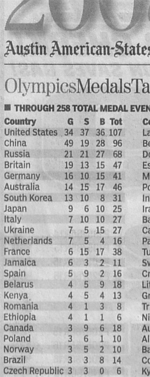
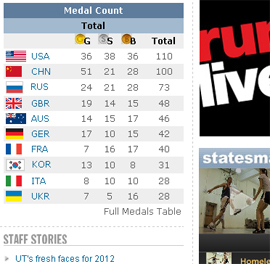
Computer Theology studies the respective roles of trust and policy, in both human societies and computer networks.
Olympic medals were published August 24th, 2008 in the Austin American-Statesman. The policy was evidently to list medals by ordering first on gold medals.
However, in a possible conflict between trust and policy, the United States were listed first, albeit with less gold medals than China. In the web version, trust and policy concord, in an ordering based on the total number of medals. (24-Aug-08 1:45 pm CST: www.statesman.com/sports/content/sports/other/olympics.html)
Definition of trust
Definition of religion
Aesthetics and symmetry
Donald E. Knuth. The Art of Computer Programming:
Volume 1. Fundamental Algorithms, Third Edition. Reading, Massachusetts: Addison-Wesley, 1997. ISBN 0-201-89683-4
Volume 2. Seminumerical Algorithms, Third Edition. Reading, Massachusetts: Addison-Wesley, 1997. ISBN 0-201-89684-2
Volume 3. Sorting and Searching, Second Edition. Reading, Massachusetts: Addison-Wesley, 1998. ISBN 0-201-89685-0
Hermann Weyl. Symmetry. Princeton, New Jersey: Princeton University Press, 1952. ISBN 0-691-02374-3.
Recursion
Going beyond Computer Theology, one may wonder about other possibilities of recursion. A frightening thought is that from individual suicide to communal forms of suicide, is there an end to that recursion?
Abraham H. Maslow. Toward a Psychology of Being. Van Nostrand Reinhold Company, New York, NY, 1968. Library of Congress Catalog Card Number 68-30757
Theory of Content and Content Model
(1) Jerry A. Fodor A Theory of Content pp. 230-249 Mind and Cognition: An Anthology. William G. Lycan (editorr), Blackwell Publishing, 1999, ISBN 0-6312054-5-4
(2) A Semantic Web Content Model and Repository. Max Völkel. pp. 254-261. Proceedings of the 3rd International Conference on Semantic Technologies, Graz, Austria. September 2007. xam.de/2007/2007-05-voelkel-ISEMANTICS-swcm-CR.pdf
To Bruce Schneier
"That's what a good design looks like. It's not just secure against known attacks; it's also secure against unknown attacks. We need more of this, not just on the internet but in voting machines, ID cards, transportation payment cards ... everywhere. Stop assuming that systems are secure unless demonstrated insecure; start assuming that systems are insecure unless designed securely."
Computer Theology shows how a computer can defend against unknown attacks using mechanisms similar to humans, i.e. guiding mythologies, and then theologies, that provide repeatable and transmittable guides for action. Their working is their warrant of survival, less they adapt. How such mythologies and theologies are provisioned in the mind is the other subject that Computer Theology covers on the topic, showing how rituals linked with ecstatic states convey between human and computer societies.
Reference: Bruce Schneier, Chief Security Technology Officer, BT, http://www.schneier.com, the quote is at http://www.schneier.com/crypto-gram-0808.html#11.
Review
Our thinking is that we're not diverging, but rather constructing our argument with the rigor it deserves, taking each trace of similarity between human societies and computer networks and following it to enough length that we are comfortable with the parallel we're establishing. On this we got good reviews, but readers will need to judge by themselves. We sure appreciate the feedback.
Artificial Life
Computer Theology then explains how this construction of minimal descriptions is the basis for mimetics and then metaphoric elaboration at the center of our cognitive system. The mechanism of evaluation via minimum descriptions is a foundation for the trust system that allows progressive self-actualization.
The associated paper clearly explains what's going on in the video:
Ralf Der, Frank Güttler, Nihat Ay (2008). Predictive information and emergent cooperativity in a chain of mobile robots. In S. Bullock, J. Noble, R. A. Watson, and M. A. Bedau (Eds.) Proceedings of the Eleventh International Conference on Artificial Life, MIT Press, Cambridge, MA. [To appear: the link above is to the conference pre-proceedings]
Metaphors
George Lakoff and Mark Johnson (1980). Metaphors We Live By. Chicago, IL: University of Chicago Press. ISBN 0-226-44801-1.
To the Olympics
To Daniel Dennett
Daniel C. Dennett (2006). Breaking the Spell: Religion as a Natural Phenomenon. Penguin Books, New York, New York. ISBN 0-670-03472-X
To Justin Barrett
[1] Barrett, Justin L. (2007). Is the spell really broken? Bio-psychological explanations of religion and theistic belief, Theology and Science, 5:1, 57 - 72. URL: http://dx.doi.org/10.1080/14746700601159564
To Stuart A. Kauffman
Stuart A. Kauffman. Reinventing the Sacred: A New View of Science, Reason, and Religion. New York, New York: Basic Books, 2008. ISBN 978-0-465-00300-6.
To Maupertuis
Page 11, Tome 1, Essai de cosmologie:
But couldn't we say that in the fortuitous combination of Nature's production, as there were only the ones which had certain rapports of convenience, which could subsist, isn't it marvelous that this convenience is found in all the species that currently exist? Chance, could we say, had produced an innumerable multitude of individuals; a small number found itself built in such a way that the parts of the animal could satisfy its needs; in another infinitely larger, there was no convenience, nor order: all those died; animals without mouth couldn't live, others that were lacking organs for generation couldn't reproduce: the only ones that would remain are those where order and convenience are found; and those species, that we see today, are only the smallest part of what a blind destiny had produced.
Page 84, Tome 2, Vénus physique:
It is true that when we say that the embryo is formed by the mixture of both semens, we are far away from having explained this formation: however, the obscurity, that remains, should not be held against the way we reason. Who wants to know an object laying too far, and who discovers it only confusedly, has better success than who sees more distinctively objects that don't make up that one.
Although I respect infinitely DESCARTES, and that I believe, like him, that the embryo is formed with the mixture of both semens, I cannot believe that anybody be satisfied with the explanation he gives, neither that we can explain by an intelligible mechanics how an animal is formed by the mixture of two liquors. But however the manner by which this prodigy is done keeps being hidden for us, I still believe is nonetheless certain.
Page 90, Tome 2, Vénus physique:
If each part is united to those that should be its neighbors, and only to those, the infant is born into perfection. If some parts are too far away, or of a form that is not appropriate, or too weak in union rapport to unite to those to which they should be united with, there is born a monster by default. But if it happens thats superfluous parts still find their place, and unify with parts whose union was already sufficient, here is a monster by excess.